

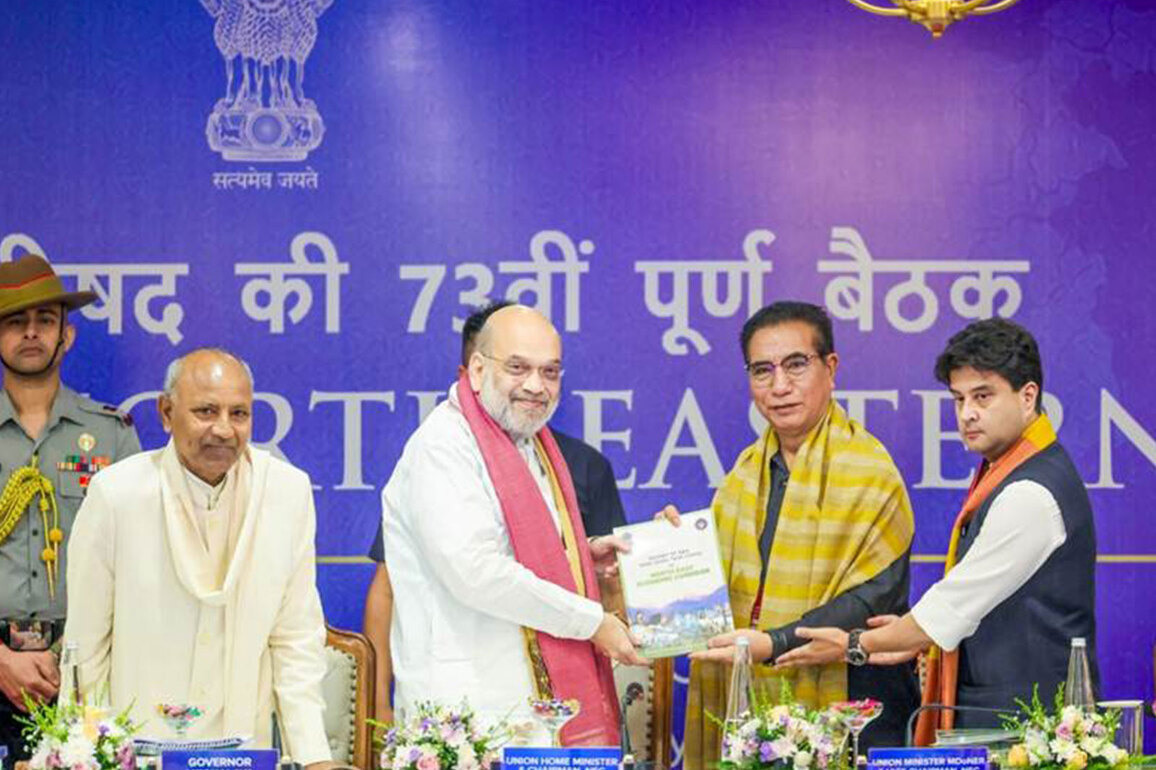
New Delhi [India], June 4 (ANI): Union Home Minister and Minister of Cooperation, Amit Shah, on Thursday, chaired the 73rd Plenary Session of the North Eastern Council (NEC) in Shillong, the capital of Meghalaya.
As per the official release, the meeting was attended by Union Minister for Development of North Eastern Region (MDoNER), Jyotiraditya Scindia, Governor of Meghalaya, CH Vijayashankar; Chief Minister of Meghalaya, Conrad Sangma; Union Minister of State for Development of North Eastern Region, Sukanta Majumdar; Union Home Secretary, Govind Mohan and Secretary, Ministry of Development of North Eastern Region (MDoNER), Sanjay Jaju. Governors and Chief Ministers of Arunachal Pradesh, Assam, Manipur, Tripura, Mizoram, Nagaland, and Sikkim, along with several other distinguished dignitaries, were also present at the meeting.
Addressing the meeting, Shah said that under the leadership of Prime Minister Narendra Modi, focused efforts have been made over the past 12 years to accelerate the development of the North East. He stated that a developed North East is now being built on the strong foundation laid during this period, and that all the states of the region have witnessed significant qualitative transformation over the last 12 years.
Shah said that, apart from PM Modi, there has perhaps been no Prime Minister who has worked with such sustained focus and commitment towards the development of the North East.
Shah said that the foundation of development can only be laid on the pillars of good law and order and social harmony. He noted that, over the past 12 years, more than 12 peace accords have been signed to resolve various conflicts in the North East, and over 10,800 youth have been brought into the mainstream after laying down their arms.
Shah stated that the Modi Government has freed the North East from the scourge of insurgency. He said that the region has witnessed systematic infrastructure development over the last 12 years, and that improved rail, road, and air connectivity has significantly reduced the distance between Delhi and the North East.
He further said that the region's infrastructure has grown many times during the 12 years of the Modi Government.
Shah added that Prime Minister Modi has not only reduced the geographical distance between Delhi and the North East but has also bridged the emotional distance between the people of the region and the rest of the country.
Shah said that Prime Minister Modi has worked with complete commitment and sensitivity for this vast region through a Whole-of-Government Approach. He stated that over the past 12 years, the diversity of the North East has emerged as a major strength in the world.
Shah said that today, the entire world recognises the North East as an opportunity hotspot. He noted that while the region was once known primarily for its conflicts, it is now recognised for its spirit of coexistence and harmony. The Home Minister further said that it is the collective responsibility of all stakeholders to preserve and strengthen the rich diversity of the North East, which is home to more than 200 tribal groups, over 195 dialects, and a wide range of cultures, cuisines, and traditional attire.
Shah emphasised that by revitalising and nurturing this shared cultural heritage, the vision of Ashtalakshmi envisioned by Prime Minister Modi can be translated into reality on the ground.
He said that the Government has been successful in translating the principles of 'Act East, Act Fast, and Act First' into reality on the ground. He emphasised that the North East has not been left to fend for itself, and that its development has been pursued through a focused and committed approach.
Shah stated that development cannot be achieved through budgetary allocations alone; it also requires a clear vision, sound planning, and meticulous monitoring of implementation.
The Home Minister said that all these elements have been effectively pursued during the 12 years of the Modi Government. He further noted that the entire North East has progressed by overcoming the challenges of establishing peace and stability, initiating prosperity and development, and preserving its unique cultural identity.
Union Home Minister and Minister of Cooperation said that the important report of the High-Level Task Force on the development, prosperity, and preservation of the cultural identity of the North East is akin to a guiding scripture. He urged the states to utilise all budgetary provisions available under various parameters and work towards achieving 100 per cent implementation of the recommendations contained in the report.
He emphasised that the future priorities of the North East should now be shaped on the basis of this report. Shah said that, through the Rising North East Investment Summit, all eight North Eastern states can benefit from the establishment of ancillary industries linked to major industrial investments, particularly by locating such units in the smaller states of the region. He noted that, apart from the investments committed during Assam's Investment Summit, the North East has attracted investments worth approximately Rs 4.25 lakh crore, reflecting the strong focus on industrial development in the region.
Shah highlighted that major projects such as the semiconductor plant being established in Assam with an investment of around Rs 27,000 crore, the development of the North East as a healthcare hub for the region and several neighbouring eastern countries, and the Namrup Ammonia-Urea Complex aimed at reducing logistics costs, have accelerated development across several North Eastern states.
Shah said that the Single Window Clearance mechanism should not remain merely a concept on paper, and that its implementation should be reviewed on a monthly basis by the Chief Ministers and Governors of all the North Eastern states. He emphasised that the development of Guwahati, Imphal, and Agartala as multimodal logistics hubs should be completed within stipulated timelines through continuous monitoring. He further stated that all North Eastern states should strive to become self-reliant in the production of fish, eggs, and milk, and should aim to supply surplus production to other parts of the country.
Shah noted that in several Indian states, the dairy sector has become a key driver of prosperity for farmers and livestock rearers. The Home Minister said that the National Dairy Development Board (NDDB), in collaboration with the Ministry of Cooperation, is initiating a renewed effort in the region. He informed that a target has been set to supply more than 50,000 milch animals annually to the North Eastern states through NDDB from the next financial year onwards, along with the creation of a robust cooperative framework for milk collection and marketing.
Shah added that improving infrastructure connectivity, promoting planned and integrated urbanisation, and developing 15 high-potential sectors should remain key focus areas for all the states in the North East.
Union Home Minister said that water resources and natural wealth play a vital role in any model of development, and that the North Eastern states are richly endowed with both.
He emphasised that the North Eastern Council (NEC) should not function merely as a platform for the distribution of funds, but should evolve into an institution for strategic planning and long-term regional development.
Shah said that the Government aims to enhance the utilisation of human resources across states and that this objective can be effectively achieved throughout the North East through connectivity and coordination via West Bengal. He further stated that the Government has opened a major gateway for trade across the eastern region through the Sabroom Land Port. The Home Minister said that the North East is now prepared to expand trade and economic engagement with Southeast Asian countries and the broader Indo-Pacific region.
Shah said that the more than 200 tribal communities and over 200 languages and dialects of the North East must be preserved. He noted that the region has, for thousands of years, fostered coexistence among diverse communities, and that this diversity must be transformed into a source of strength. The Home Minister emphasised that the loss of even a single language or dialect from the North East would constitute a significant loss for the nation.
Shah urged all the states in the region to work with dedication and commitment to preserve the unique identity of the North East, stating that this cultural richness can become one of the region's greatest strengths. The Home Minister said that under the PM-DevINE scheme, Prime Minister Modi has approved cluster projects worth Rs 65 crore in Assam and Tripura, and that these initiatives should be developed as model projects for the region.
Shah further stated that around 215 crops and products from the North East are currently potential contenders for Geographical Indication (GI) tags.
He suggested that each state should establish a dedicated task force to continuously monitor and facilitate the entire process of obtaining GI tags.
Shah also said that the North East is the ideal destination for the Healing India Mission, and called upon all states in the region to formulate comprehensive policies for wellness infrastructure and health tourism, leveraging the region's natural advantages and rich traditional knowledge systems.
Amit Shah said that under the Modi Government, the number of civilian casualties in the Northeast has declined by 86 per cent over the past 12 years, which is a remarkable achievement. He noted that more than 12 historic peace accords have created a highly conducive environment for development in the region.
Shah said that the Government of India has formulated a special action plan with a ruthless approach to eradicate both the transportation and consumption of narcotics in the Northeast.
He emphasised that all Chief Ministers of the Northeastern states should focus on making citizens aware of their constitutional rights and ensuring their protection, as insurgency in the region has been largely eliminated. The Home Minister said that the Northeast should make a fresh beginning in the area of routine policing. Protecting the rights of the poor, women, and children should be our priority.
He stressed the need to ensure timely justice under the new NayayaSanhita, promote the use of technology in the criminal justice system, enhance conviction rates through the application of forensic science, and establish a comprehensive framework encompassing online registration of cases and online testimony in courts, so that every citizen receives his or her rightful entitlements and justice.
Shah said that the youth of the North East have the potential to excel in digital skills such as Artificial Intelligence (AI), Data Analytics, Machine Learning, and Blockchain. He emphasised that efforts should be made to develop the entire North East into a major hub for the IT industry.
He further stated that the region possesses immense potential in both hydropower and solar energy, which can be leveraged for sustainable economic growth.
The Home Minister also stressed the need to attract data centres to the North East. He said that this objective can be achieved by aligning the region's education system, industrial development roadmap, and long-term vision for the utilisation of its natural resources, thereby creating a strong foundation for a technology-driven economy. (ANI)